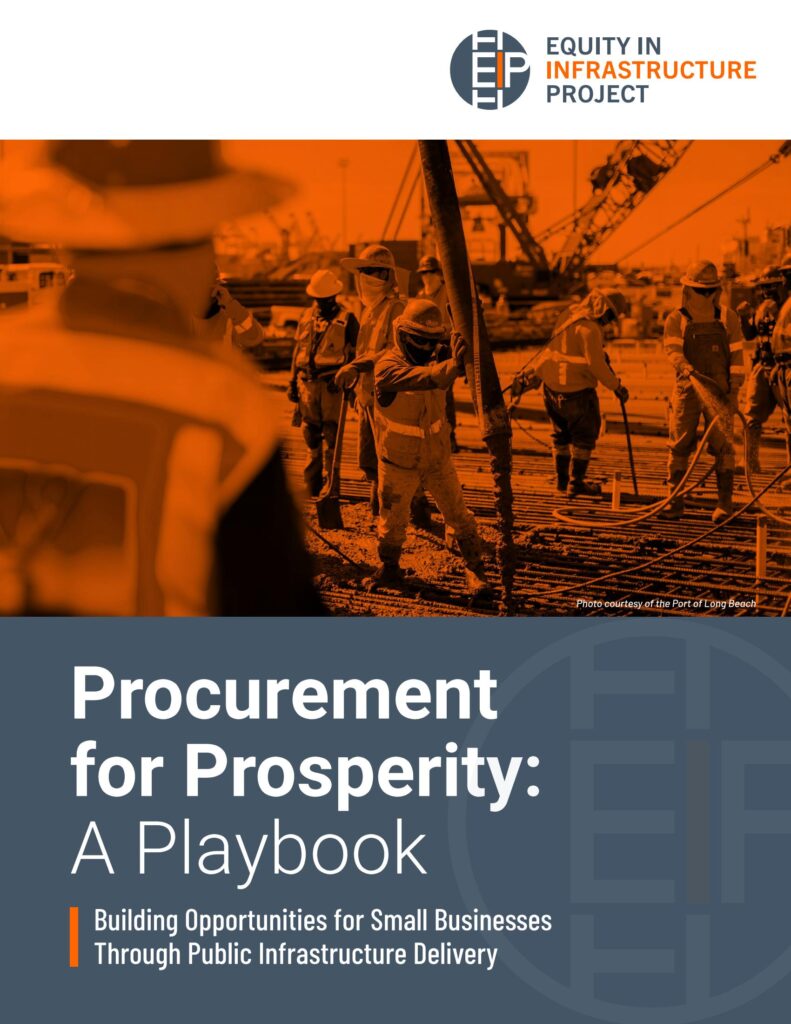
Public infrastructure agencies are operating in a period of structural change. Construction costs continue to rise, competition for public contracts has narrowed, and long-standing federal contracting frameworks are being reassessed at both the federal and state levels. In that context, the Equity in Infrastructure Project has released “Procurement for Prosperity: A Playbook,” a resource intended to document procurement practices that agencies report have expanded competition and improved access for Historically Underutilized Businesses in race- and gender-neutral environments.
Released February 11, 2026, the Playbook does not introduce new policy prescriptions or regulatory proposals. Instead, it compiles tools, contracting structures, and administrative practices currently in use by public agencies, airports, utilities, and private-sector partners. The document is organized around practical procurement strategies — including project forecasting, outreach, evaluation processes and contract structuring — alongside executive-level guidance on implementation, internal alignment and performance monitoring.
Cost pressures and the case for competition
The Playbook situates procurement reform within a broader economic context shaped by rising construction costs and industry consolidation. Real spending per mile on Interstate highway construction has increased substantially over time, while consolidation across the construction industry has reduced the number of firms competing for public work. Fewer bidders, the document notes, can contribute to higher prices and reduced flexibility for agencies managing constrained capital budgets. “More competition means more small business growth, more local jobs and reduced costs for public infrastructure agencies. We have to be in the business of maximizing value, and the way to get there is by learning from each other,” said Phillip A. Washington, CEO of Denver International Airport and an Equity in Infrastructure Project co-chair.
Operating in a changing policy environment
Several contributors to the Playbook emphasize that the strategies it documents are not dependent on race- or gender-based program structures. Instead, they reflect procurement methods agencies have used in neutral contracting environments, in some cases for decades. The Playbook defines Historically Underutilized Businesses broadly, allowing agencies to apply locally determined definitions that extend beyond traditional certification categories such as DBE or MWBE. “As the Playbook lays out, many agencies have operated in a race- and gender-neutral context, in some cases for decades, showing a clear path forward despite the end of the DBE program and other federal actions,” said John Porcari, a former deputy U.S. secretary of transportation and an Equity in Infrastructure Project co-chair.
A coalition-based, practice-oriented resource
The Playbook was developed with support from Partners for Public Good, a nonpartisan nonprofit organization focused on improving government performance. Its development included independent research, facilitated workshops, and interviews with procurement and executive leadership. Contributing organizations span public agencies, infrastructure owners, engineering firms and industry associations across multiple regions. “The daily complexities of running an airport, transit authority or similar entity mean no agency should go it alone, nor can they,” said Dorval R. Carter Jr., former president of the Chicago Transit Authority and an Equity in Infrastructure Project co-chair.
For small and diverse firms operating in transportation, infrastructure and related professional services, the Playbook offers insight into how public owners are reevaluating access to work amid cost pressures and legal uncertainty. While it does not resolve broader policy debates surrounding federal contracting programs, it documents how agencies are adapting procurement practices in real time, with an emphasis on competition, capacity and value.
Here is a link to the Playbook:
https://equityininfrastructure.org/eip-playbook-pdf